
FR4 PCB material guide
FR4 PCB Material Guide: Grades, Tg, Td, Dk & Selection
FR-4 is a class of glass-epoxy laminates, not one product. Here is how standard, mid-Tg, high-Tg, halogen-free and low-loss FR-4 differ, and which one your board needs.
- Tg range
- 130–180 °C
- Dk range
- 4.0–4.8
- Df @ 1 GHz
- ≈0.02
- Flame retardant
- UL 94 V-0
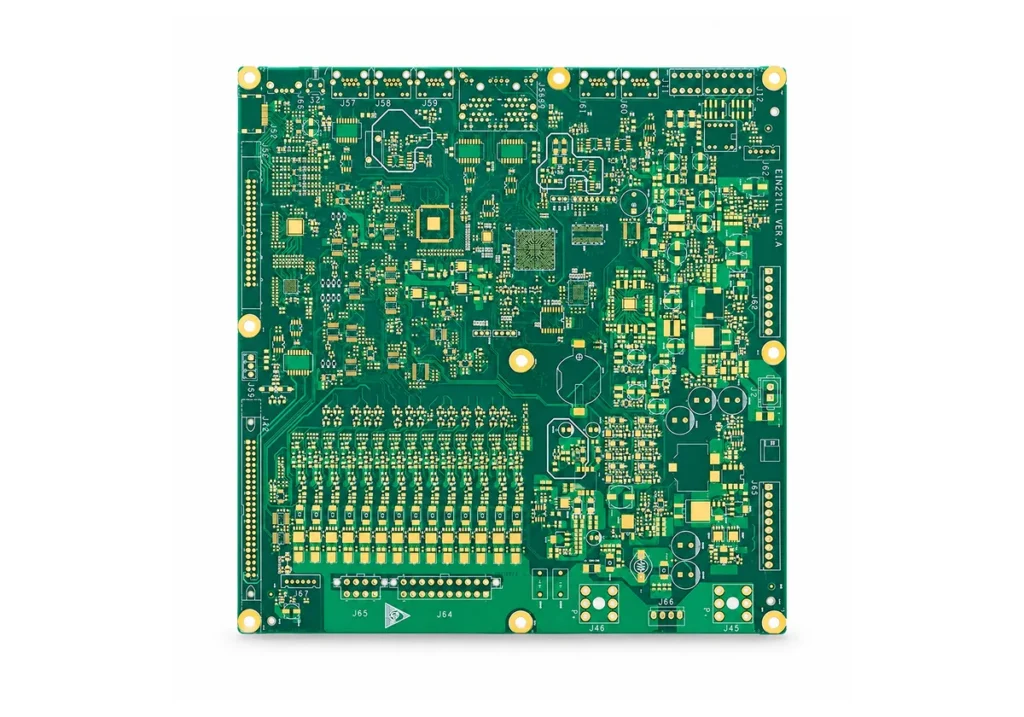
What FR-4 is
What is an FR4 PCB?
An FR4 PCB is built on FR-4, a flame-retardant (UL 94 V-0) composite of woven fiberglass cloth and epoxy resin. “FR” stands for flame retardant and “4” is the NEMA grade. FR-4 is a class of materials, not a single product, so Tg, Td, Dk, CAF resistance and cost vary widely between formulations.
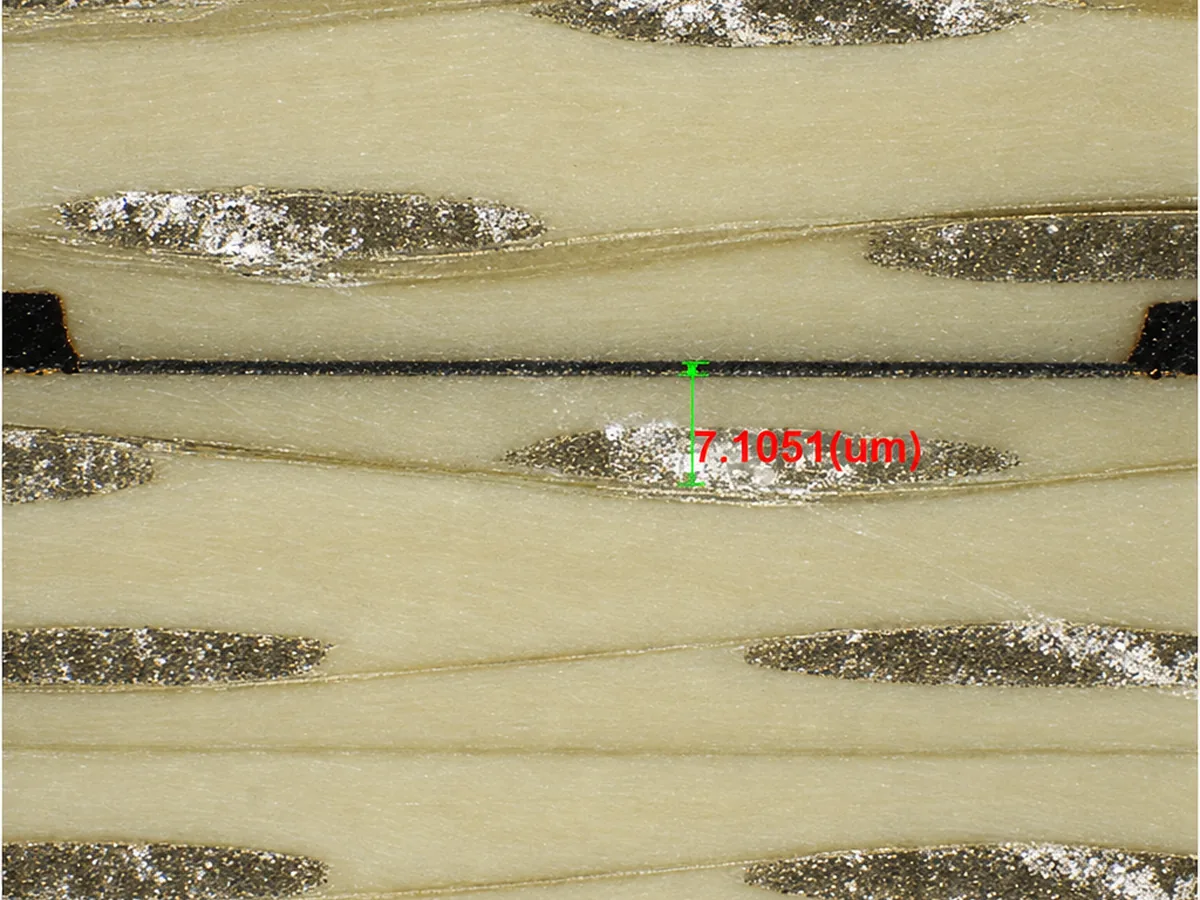
The glass gives mechanical strength and dimensional stability; the epoxy is the dielectric, bonds the stack during lamination and provides flame retardance through brominated or, in halogen-free grades, phosphorus-based additives. FR-4 is used in the large majority of rigid PCBs worldwide because it balances cost, strength, processability and electrical performance.
Glass transition temperature
Glass transition temperature (Tg) and FR-4 CTE.
Tg is where the epoxy changes from rigid and glassy to soft and rubbery. Above Tg the resin expands rapidly in the z-axis, stressing plated through-holes and via barrels. Standard FR-4 with Tg 130–140 °C was fine for tin-lead assembly (peak about 220 °C). Lead-free reflow peaks of 245–260 °C push the board well above standard Tg, so every reflow cycle adds more z-axis stress.
Mid-Tg (150–170 °C) and high-Tg (170–180 °C, such as Isola 370HR) grades give progressively more margin. For any board that will see lead-free assembly, mid-Tg or high-Tg FR-4 is recommended, and high-Tg is the norm for thick or high-layer-count boards.
Decomposition temperature
Thermal decomposition temperature (Td).
Td is where the resin starts to decompose irreversibly, losing weight and releasing volatiles. It is always well above Tg: about 300 °C for standard FR-4 and 340 °C for high-performance grades such as 370HR. Td matters for anything that holds the board above Tg for a while, including wave soldering, selective soldering, multiple reflows and rework. A higher Td gives more margin before delamination.
Dielectric properties
Dielectric properties and high-frequency performance.
FR-4 Dk ranges from about 4.0 to 4.8 depending on resin content, glass style and frequency, a much wider spread than the ±0.05 of an RF laminate. For controlled impedance, use the Dk of the actual laminate and glass style; assuming a generic 4.2 can cause 5–10% impedance error.
Standard FR-4 Df is about 0.02 at 1 GHz and rises with frequency. That is acceptable for digital designs up to roughly 1–2 GHz, depending on trace length and loss budget. For 10 Gbps+ interfaces such as PCIe Gen 4/5, 25GbE or 56G PAM4, use low-loss laminates such as Megtron 6 or Isola FR408HR.
Common FR-4 grades
FR-4 grades compared.
| Grade | Tg | Typical examples | Use |
|---|---|---|---|
| Standard | 130–140 °C | Shengyi S1141, Kingboard KB-6160 | Low cost, tin-lead or simple lead-free |
| Mid-Tg | 150–170 °C | ITEQ IT-158, Shengyi S1150G | Lead-free with standard reliability |
| High-Tg | 170–180 °C | Shengyi S1000-2M, ITEQ IT-180A, Isola 370HR | Automotive, industrial, thick multilayer |
| Low-loss FR-4 class | ≈ 180 °C+ | Isola FR408HR, Megtron 4 | Moderate high-speed digital |
| Halogen-free | Varies | Phosphorus-based systems | Environmental compliance |
FR-4 brands
Shengyi and ITEQ FR-4 laminates.
Shengyi (SYTECH) and ITEQ are our default general-purpose FR-4 suppliers and cover most rigid, multilayer and HDI builds. Shengyi S1141 is a standard-Tg workhorse; S1000-2M and S1000H are high-Tg, CAF-resistant grades for lead-free and automotive work. ITEQ IT-180A is a widely specified high-Tg FR-4, and IT-968 / IT-988G are low-loss grades for high-speed digital. If your drawing names a specific laminate we build on it; if it allows an equivalent, we propose one at quote and only use it with your approval.
| Brand | Grade | Class | Typical use |
|---|---|---|---|
| Shengyi | S1141 | Standard Tg (≈ 140 °C) | Consumer and general electronics |
| Shengyi | S1000-2M / S1000H | High Tg (≈ 180 °C) | Automotive, industrial, thick multilayer |
| ITEQ | IT-180A | High Tg (≈ 175 °C) | Lead-free multilayer and HDI |
| ITEQ | IT-968 / IT-988G | Low loss | High-speed digital, networking |
Choosing
Choosing the right FR-4 grade.
- Prototype or cost-sensitive, tin-lead: standard Tg
- Lead-free with standard reliability: mid-Tg
- Automotive, industrial, 8+ layers or many reflows: high-Tg with CAF resistance
- Above ~5 Gbps: check channel loss; consider low-loss FR-4 or Megtron 6
- RF above ~1 GHz: Rogers or a hybrid stack-up
- Tight impedance: name the exact laminate, not just “FR-4”
Thickness
Common FR-4 board thicknesses.
| Finished thickness | Typical use |
|---|---|
| 0.4–0.8 mm | Thin modules, wearables |
| 1.0–1.2 mm | Compact consumer boards |
| 1.6 mm (0.062 in) | Industry default |
| 2.0–2.4 mm | Industrial, connectors, heavier parts |
| 3.2 mm+ | Backplanes, high layer count |
Halogen-free
Halogen-free FR-4.
Halogen-free FR-4 replaces brominated flame retardants with phosphorus-based systems. It meets the same UL 94 V-0 rating and supports environmental programs that restrict halogens. It is often slightly stiffer and can have different Dk and drilling behaviour, so treat it as a named material in impedance and DFM planning rather than a drop-in substitute.
Specifying
How to specify FR-4 on a drawing.
“FR-4” alone leaves the fabricator free to use any standard-Tg laminate. If your board needs more, write it down: minimum Tg, minimum Td, CAF resistance, halogen-free status, IPC-4101 slash sheet where you use one, and whether equivalent substitutes are acceptable. For controlled impedance, name the laminate family and glass style, or let us propose a stack-up with the actual Dk values.
- Minimum Tg (e.g. ≥ 170 °C)
- Minimum Td (e.g. ≥ 340 °C)
- CAF-resistant requirement
- Halogen-free if needed
- IPC-4101 slash sheet (optional)
- Substitution allowed: yes / no
Limits
Where FR-4 falls short.
FR-4’s wide Dk spread and Df around 0.02 cause high loss at multi-GHz frequencies, and standard grades are limited to about 130 °C operation. For those designs use a high frequency or high speed laminate, polyimide for high temperature or flex, or a hybrid stack-up that keeps FR-4 on the non-critical layers.
FAQ
Material questions.
What does FR-4 stand for?
Flame Retardant, NEMA grade 4: a glass-reinforced epoxy laminate rated UL 94 V-0.
What is the Dk of FR-4?
About 4.0–4.8 depending on resin content, glass style and frequency.
What is the Tg of FR-4?
Standard grades 130–140 °C, mid-Tg 150–170 °C and high-Tg 170–180 °C.
When should I use high-Tg FR-4?
For lead-free assembly, thick or high-layer-count boards, multiple reflows and harsh environments.
What are the limitations of FR-4?
High dielectric loss above a few GHz, Dk variation with frequency and limited operating temperature for standard grades.
Can FR-4 be used for RF?
Below about 1–2 GHz with short traces, or for digital layers in a hybrid stack-up; above that use Rogers or PTFE.
What is the FR-4 CTE?
FR-4 CTE in-plane (X/Y) CTE is typically about 12–16 ppm/°C. Z-axis CTE is about 40–60 ppm/°C below Tg and rises several times above Tg, which is why high-Tg grades protect plated holes better.
Which FR-4 brands do you use?
Shengyi and ITEQ by default, plus Isola, Panasonic and other specified laminates. Equivalent grades are only used with your approval.
Ready when your files are
Send your stack-up for a material check.
Upload Gerber, ODB++ or IPC-2581 data. Every quote includes a written engineering DFM review, typically within one business day.