
RF PCB materials · Rogers · PTFE · Arlon
RF PCB Materials: Rogers, PTFE, Arlon & Hybrids Compared
How to choose an RF laminate: Dk, Df, stability and cost compared across FR-4, Rogers RO4000, PTFE, Arlon and Taconic, plus when hybrid stack-ups make sense.
- Dk range
- 2.2–10.2
- Lowest Df
- <0.001
- Also supported
- Arlon
- RF + FR-4
- Hybrid
Overview
Choosing an RF laminate.
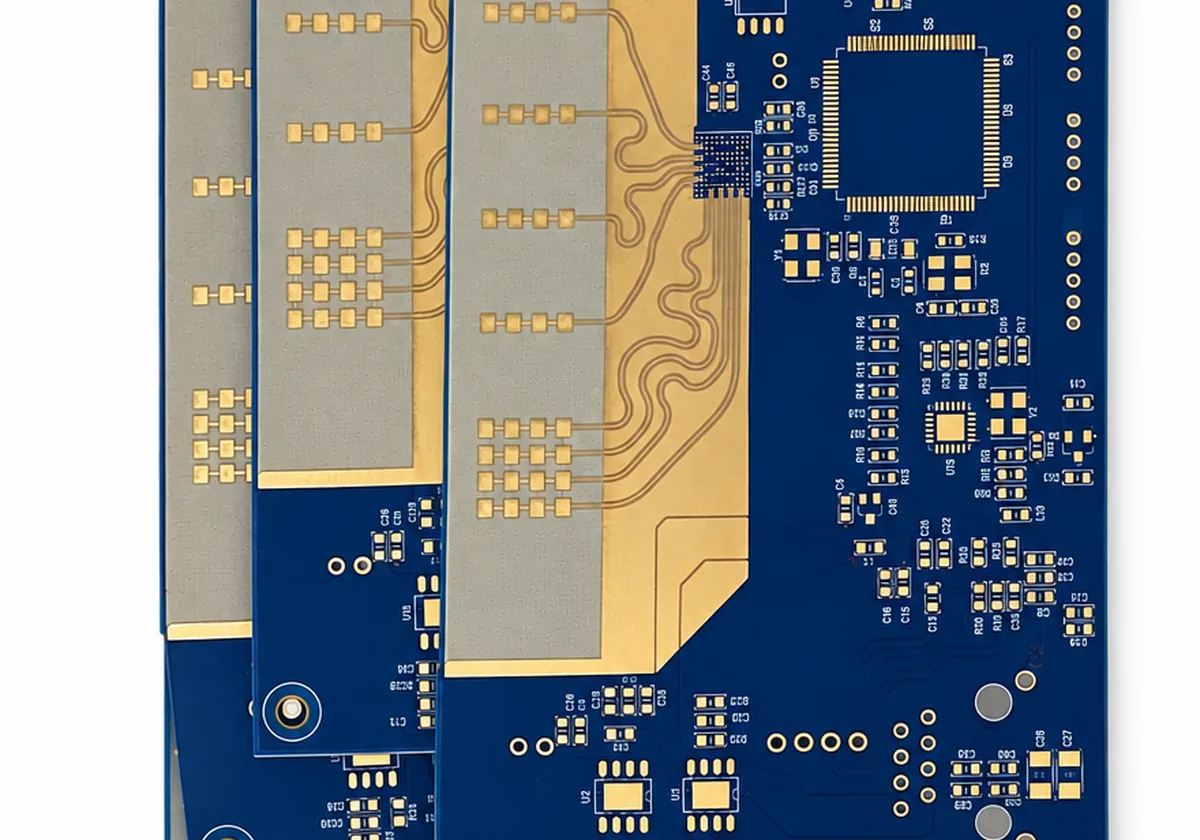
RF PCB materials are laminates with low, stable dielectric constant and low dissipation factor, chosen so impedance, phase and insertion loss stay predictable at RF and microwave frequencies. The main families are hydrocarbon/ceramic (Rogers RO4000), PTFE-based (RT/duroid, Taconic, Arlon) and hybrids that combine them with FR-4 or Megtron.
Material choice sets the performance ceiling of every microwave circuit. Pick the wrong one and you lose margin. Pick an unnecessarily expensive one and you waste budget and lead time. This guide compares the families we fabricate and explains when each is the right call.

Key parameters
The parameters that matter.
| Parameter | What it controls |
|---|---|
| Dk (dielectric constant) | Wavelength in the board, trace width for an impedance, circuit size |
| Df (dissipation factor) | Dielectric loss per unit length |
| TCDk | How filters and antennas drift with temperature |
| Moisture absorption | Stability in humid or outdoor environments |
| CTE (z-axis) | Plated-hole reliability and hybrid bonding |
| Processability | Whether FR-4 processes work or PTFE handling is needed |
Dk sets the physical size of microstrip lines and resonators. Df sets how much signal turns into heat. For long lines and high frequencies, Df dominates. Stability of Dk with temperature, frequency and humidity decides whether a tuned circuit stays tuned in the field.
Comparison
RF material comparison.
| Material | Dk | Df @ 10 GHz | Use |
|---|---|---|---|
| FR-4 | 4.0–4.8 | ≈ 0.02 | Below ~1–2 GHz or digital layers |
| RO4350B | 3.48 | 0.0037 | 1–20 GHz default |
| RO4003C | 3.38 | 0.0027 | Lower loss, tight link budgets |
| RO3003 | 3.00 | ≈ 0.001 | 77 GHz radar antennas |
| RT/duroid 5880 (PTFE) | 2.20 | 0.0009 | mmWave, lowest loss |
| Arlon PTFE/ceramic grades | ≈ 2.2–3.5 | low | Antennas, military RF |
| Taconic RF-35 / TLY | ≈ 2.2–3.5 | low | Antennas, radar |
Rogers RO4000
Rogers RO4000 series.
RO4000 (RO4003C and RO4350B) is a glass-reinforced hydrocarbon/ceramic that processes on standard FR-4 equipment, with no special drilling, handling or lamination. That makes it the most cost-effective Rogers family and the default when Df of 0.003–0.004 meets the requirement. RO4350B is the higher-volume, lower-cost, V-0-rated option. RO4003C has about 25% lower loss when the link budget needs it. Both offer good Dk stability (TCDk around +40 to +50 ppm/°C). More on Rogers PCB laminates.
PTFE
PTFE-based laminates.
PTFE laminates give the lowest Df available in PCB substrates, below 0.001 at 10 GHz for low-filler grades. They are specified where insertion loss must be minimized: satellite transponder filters, radio astronomy receivers, test-equipment standards and mmWave radar and 5G. Dk around 2.1–2.2 gives wider traces and larger circuits than Rogers hydrocarbon laminates.
The trade-off is fabrication difficulty. PTFE is soft, so drilling must be tuned to prevent smear and delamination, and it needs plasma or sodium etch plus specialized bonding for multilayer builds. Fabrication cost is significantly higher than for RO4000, and not every fabricator has PTFE experience.
Arlon & Taconic
Arlon PCB, Taconic and Wangling laminates.
Arlon PTFE and ceramic-filled laminates, and polyimide grades such as Arlon 85N, appear in antenna, military and space RF designs, often as legacy or already-qualified materials on long-running programs. Taconic RF-35 and TLY grades offer PTFE options with different glass styles and Dk ranges. We fabricate Arlon PCBs and Taconic boards when they are specified. Wangling F4B / F4BM PTFE is a cost-effective domestic option for antennas and base-station RF when an equivalent is allowed. Stock and lead time vary by grade and region, so we confirm availability at quote and can propose qualified equivalents if you allow substitution.
Hybrid
Hybrid RF/digital stack-ups.
Many RF products combine an RF front end with digital baseband on one board. A hybrid stack-up puts RF layers on Rogers or PTFE and digital layers on FR-4 or Megtron, bonded with suitable prepreg or bondply. Expensive RF laminate goes only where it is needed.
The bonding interface needs care. CTE mismatch between Rogers and FR-4 creates stress during lamination and reflow that can cause delamination if it is not managed. We validate the hybrid construction, press profile and drill parameters before the design is finalized. See high frequency PCB.
- RF layers on outer Rogers/PTFE cores
- Compatible bonding material at the RF/FR-4 interface
- Balanced construction to limit warp
- Microsection of bond lines on coupons
When to use each
When to use each material.
| Situation | Recommendation |
|---|---|
| RF below 1–2 GHz, short traces, relaxed loss | Standard or high-Tg FR-4 |
| General RF 1–20 GHz | RO4350B |
| RO4350B loss marginal | RO4003C |
| Above ~20 GHz or minimum loss at any frequency | PTFE (RT/duroid 5880) or RO3003 |
| Legacy or qualified program material | Arlon / Taconic as specified |
| High-speed digital on an RF combo board | Megtron 6/7 for digital layers |
FAQ
Common questions.
How do I select the right RF PCB material?
Start from frequency, trace length and loss budget. Below ~2 GHz FR-4 may suffice; 2–20 GHz usually RO4350B or RO4003C; above ~20 GHz PTFE such as RT/duroid 5880.
What is the difference between Dk and Df?
Dk sets wavelength and trace dimensions; Df sets how much signal energy is lost as heat. Lower Df means less loss.
What is the best RF PCB material?
RO4350B for most 1–20 GHz designs; PTFE for mmWave; hybrids to control cost.
Do you fabricate Arlon PCBs?
Yes, when specified; stock and lead time are confirmed at quote, and qualified equivalents can be proposed.
Do you stock RF materials?
We keep common grades such as RO4350B, RO4003C and RT/duroid 5880 in standard thicknesses; others are sourced with lead time confirmed at quote.
Can FR-4 be used for RF?
Below about 1–2 GHz with short traces, or for digital layers in a hybrid stack-up.
Ready when your files are
Send your design for a capability check.
Upload Gerber, ODB++ or IPC-2581 data. Every quote includes a written engineering DFM review, typically within one business day.