
Polyimide PCB material
Polyimide PCB Material: Properties for Flex & High Temperature
Polyimide laminate and film properties (Tg above 250 °C, Td above 400 °C, Dk 3.2–3.5, millions of flex cycles), plus adhesive vs adhesiveless constructions and where polyimide is worth its cost.
- Tg
- >250 °C
- Td
- >400 °C
- Dk
- 3.2–3.5
- Film thickness
- 12.5–50 µm

Overview
What is polyimide?
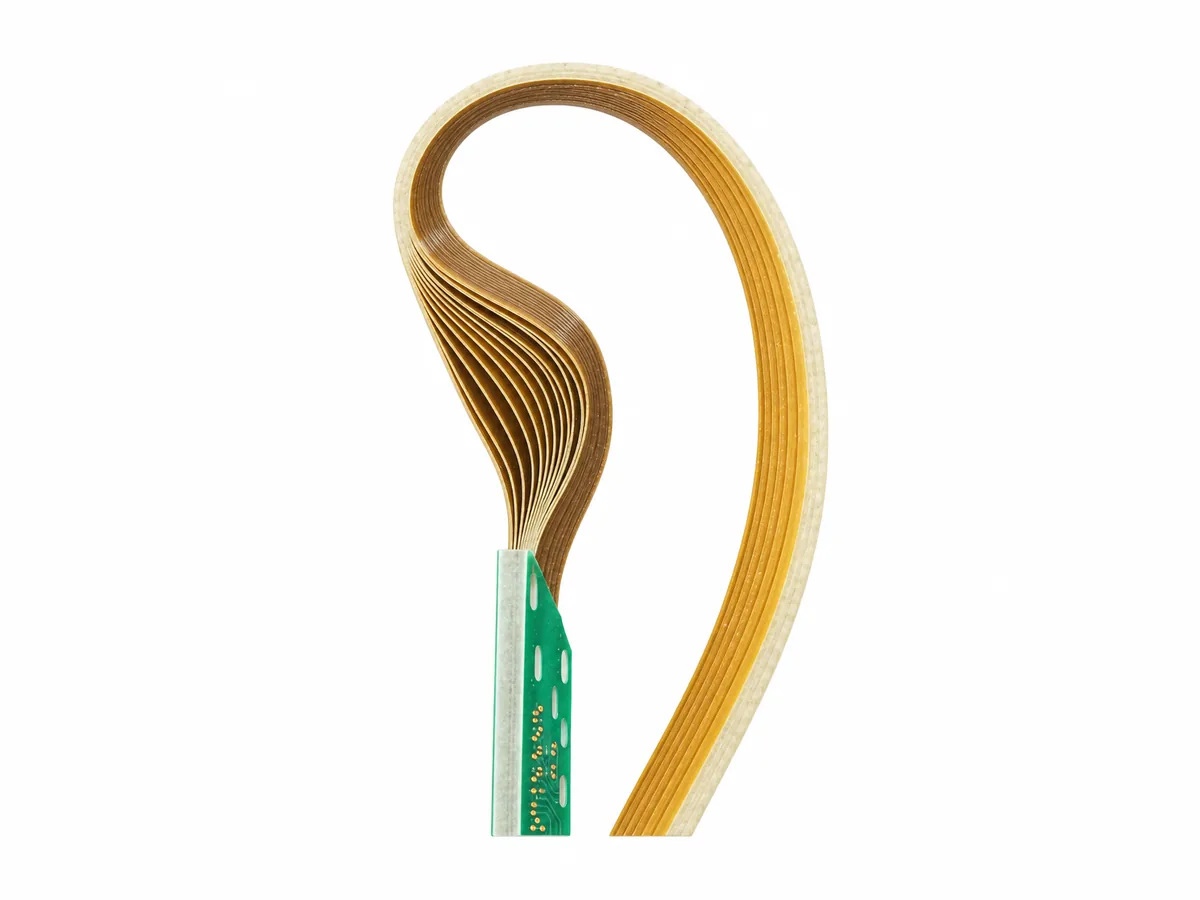
Polyimide is a high-performance polymer used as the base substrate for flexible PCBs, rigid-flex PCBs and high-temperature rigid boards. It combines continuous use above 250 °C, the flexibility to survive millions of dynamic flex cycles, chemical resistance and dimensional stability under thermal stress. It is the material of choice when FR-4 cannot meet the mechanical or environmental demands.
Kapton is DuPont’s brand of polyimide film. In PCB manufacturing, “polyimide” covers both thin flexible films for flex and rigid-flex circuits and rigid polyimide laminates for high-temperature boards. For a buyer-level overview of when to use it, see the flex PCB page.
Properties
Polyimide properties.
| Property | Typical value | vs high-Tg FR-4 |
|---|---|---|
| Tg | > 250 °C | ≈ 180 °C |
| Td | > 400 °C | ≈ 340 °C |
| Dk | ≈ 3.2–3.5 | ≈ 4.0–4.5 |
| Df | Moderate | Similar or better |
| Z-axis CTE | Lower | Higher |
| Flex life | Millions of cycles (design-dependent) | Not flexible |
| Base film | 12.5, 25, 50 µm | — |
Tg above 250 °C is nearly double that of high-Tg FR-4. Td above 400 °C leaves a large margin above lead-free reflow peaks. Lower z-axis CTE means less stress on plated through-holes during thermal cycling. Together these make polyimide the standard choice for military, aerospace and high-reliability boards that must survive extreme ranges and decades of cycling.
Electrically, Dk of about 3.2–3.5 is lower than FR-4 and Df is moderate: better than standard FR-4, but not as low as Rogers or Megtron. For most flex and rigid-flex work the selection driver is mechanical and thermal, not high-frequency loss. LCP films are an alternative for flex circuits at higher frequencies.
Flex & dynamic flex
Flex and dynamic flex applications.
Polyimide is the only practical substrate for circuits that must flex repeatedly in use: laptop and phone hinges, printer-head cables, camera modules, robotic joints and automotive harness replacements. It survives millions of flex cycles when the design respects bend-radius guidelines and uses rolled-annealed copper on the neutral axis. Static, fold-to-install bends can be much tighter than dynamic ones.
For dynamic flex, adhesiveless polyimide outlasts adhesive-based construction. The acrylic or epoxy adhesive between polyimide and copper is the most common failure point under repeated bending. Adhesiveless laminates bond copper directly to the film by casting or lamination and remove that weak link.
Adhesive vs adhesiveless
Adhesive vs adhesiveless laminates.
| Adhesiveless | Adhesive-based | |
|---|---|---|
| Thickness | Thinner | Thicker |
| Dynamic flex life | Best | Good for static |
| Temperature rating | Higher | Limited by adhesive |
| Dimensional stability | Better | Lower |
| Cost | Higher | Lower |
| Typical use | Dynamic flex, fine lines, rigid-flex | Cost-sensitive static flex |
Flex material brands
DuPont and Taiflex flex materials.
Most flex and rigid-flex boards we build use polyimide copper-clad laminates and coverlay from DuPont or Taiflex. DuPont Pyralux AP is an all-polyimide adhesiveless laminate for dynamic flex and rigid-flex; Pyralux LF and FR are adhesive-based systems for cost-sensitive static flex. Kapton is DuPont’s polyimide film. Taiflex supplies adhesiveless and adhesive-based FCCL and coverlay that are widely used in consumer and automotive flex.
| Brand | Product family | Construction | Typical use |
|---|---|---|---|
| DuPont | Pyralux AP | Adhesiveless polyimide | Dynamic flex, rigid-flex, thin builds |
| DuPont | Pyralux LF / FR | Acrylic adhesive | Static flex, cost-sensitive designs |
| DuPont | Kapton | Polyimide film / coverlay base | Coverlay and insulation |
| Taiflex | 2L / 3L FCCL, coverlay | Adhesiveless and adhesive-based | Consumer, automotive and industrial flex |
Rigid-flex
Rigid-flex applications.
Rigid-flex boards combine rigid FR-4 or polyimide sections with polyimide flex sections in one integrated structure. The flex zones replace cable assemblies, cutting connector count, assembly labor, weight and failure points. Rigid-flex is common in medical devices, military electronics, avionics and consumer products where space, weight and reliability are at a premium. See rigid-flex PCB.
High-temperature rigid
High-temperature rigid polyimide boards.
Rigid polyimide boards, not flex, are specified where operating temperature exceeds even high-Tg FR-4: downhole drilling tools, jet-engine sensors, exhaust-gas monitoring and some under-hood automotive electronics. They keep structural and electrical integrity above 200 °C and resist thermal-cycling fatigue. They also cost more and machine differently, so they are reserved for designs that really need them. See aerospace & defense.
Design
Designing with polyimide.
Flex circuits on polyimide behave differently from rigid boards. Route traces perpendicular to the bend line with curved corners, stagger traces on two-layer flex so top and bottom conductors do not stack, and keep vias and pads out of bend zones. Use hatched copper planes where the circuit must stay flexible, and add teardrops and anchoring spurs to pads so they do not peel.
Polyimide also absorbs more moisture than FR-4, so flex and rigid-flex panels are baked before lamination and before assembly. The dimensional movement of thin film during processing is larger than for rigid laminate, so fine-pitch flex features are scaled and registered specifically for the material.
- Traces perpendicular to bends, curved corners
- Stagger conductors on double-sided flex
- No vias or pads in bend zones
- Hatched planes for flexibility
- Bake before lamination and assembly
vs FR-4
Polyimide vs high-Tg FR-4.
| Need | Choose |
|---|---|
| Board must flex or fold | Polyimide |
| Continuous operation above ~180–200 °C | Polyimide |
| Rigid, below ~180 °C, lead-free reflow | High-Tg FR-4 |
| Lowest cost rigid board | Standard FR-4 |
| Higher-frequency flex | LCP or low-loss flex materials |
Cost
Cost considerations.
Polyimide is significantly more expensive than FR-4, typically 3–5× per sheet, and fabrication costs more because of coverlay, controlled adhesive curing and careful handling of thin laminates. Specify it only when the design needs its thermal or mechanical properties. For boards that just need a higher Tg without flexing, high-Tg FR-4 such as Isola 370HR is the more cost-effective upgrade.
FAQ
Common questions.
What temperature can polyimide PCBs withstand?
Continuous operation above 250 °C, with short-term exposure higher; far beyond standard FR-4 (~130 °C) and high-Tg FR-4 (~180 °C).
Is polyimide the same as Kapton?
Kapton is DuPont’s brand of polyimide film. Polyimide in PCBs covers both flexible films and rigid laminates.
What is the Tg of polyimide?
Above 250 °C, roughly double high-Tg FR-4.
Adhesiveless or adhesive polyimide?
Adhesiveless for dynamic flex, thin builds and rigid-flex; adhesive-based for cost-sensitive static flex.
How does polyimide compare to FR-4 in cost?
Typically 3–5× more per sheet, plus higher fabrication cost.
Can polyimide be used for high-frequency flex?
For moderate frequencies, yes; for higher frequencies LCP or low-loss flex materials are often preferred.
Which flex materials do you use?
DuPont Pyralux (AP adhesiveless; LF and FR adhesive-based) and Taiflex polyimide FCCL and coverlay. Other specified materials are confirmed at quote.
Ready when your files are
Send your design for a capability check.
Upload Gerber, ODB++ or IPC-2581 data. Every quote includes a written engineering DFM review, typically within one business day.